Showing posts with label travel tips. Show all posts

Thursday, June 27, 2019

Travel tips and debunking myths about Spain

Getting Around

Spain was one of the rare countries we visited where we didn't take the metro at all. For one, many of the places we visited were walking distance from the hotel and if we needed to go further afield like to the train station or airport, it meant we had our luggage, so taking a taxi was easier. Taxis are not expensive in Spain, and considering there were three of us, it was just slightly more expensive (and a lot more convenient) than taking the metro.


Also, as I've mentioned, you can try Cabify or Uber to get around. Cabify is like Grab and frequently has €3 discount codes. What I like is that you don't have to attempt to explain to the cab driver (who may not speak English) where you're trying to get to, since you just key in your destination. You also pay a fixed amount and don't have to worry about traffic bumping up your fare (which can happen if you're right smack in the Sol area in Madrid where traffic can come to a standstill).

However, something to note about Cabify: sometimes, your driver can take a long time to get to you, so you need to buffer in that time. We've had instances where our driver was 18 minutes away and had to travel a longer distance to get to us than to where we were going!

We also relied on Google maps a lot. No more getting lost with this failsafe app. Andre was the navigator for most of the trip, guiding us to attractions and restaurants. Gone are the days of wandering helplessly down wrong alleys and through mazes trying to find the right place.

Transportation

We travelled from city to city on three types of transport: plane, fast train and bus. The AVE fast train is our favourite, as it's very comfortable. But as I've mentioned, they're very popular, especially during summer when it's the holiday peak season, so you should book your tickets as early as possible. Renfe is the main rail company in Spain and they don't release the tickets in any set order - sometimes 2 months before, sometimes a month. I booked the train tickets the day they went on sale and a week later, the tickets were already 25% higher. You can book via the official Renfe site, but it's all in Spanish, so I booked from the Trainline site instead. The prices are similar and at least you can read what you're booking!


The domestic flight we took was with Vueling. It's fast and hassle-free, though the plane is pretty basic. But it got us from Barcelona to Seville in 1.5 hours, a journey that would have taken 6 hours on the fast train (and a lot more expensive), so it's definitely a good option.

The inter-city bus we took was Alsa and it's also super comfortable, with a toilet on the bus, so no worries needing to take a leak on long journeys.


We've all heard the stereotype about Spanish transportation being laid back and unreliable, but I can debunk this right now. All three types of transport that we took were impeccably efficient and organised. Even the bus left and arrived to the MINUTE that it was scheduled for. The airport, train stations and bus stations are large, modern and clean. The check in processes are fast and smooth. Mark me impressed. Unless you're unlucky enough to be there during a strike, you shouldn't have to worry about unreliability.


Language

Spanish words are relatively easy to say because they're pronounced they way they are spelt, much like Malay. Just two exceptions: 1) 'j' is pronounced 'h', eg. jamon (ham) is pronounced "hah-mon".


2) Double 'l' is pronounced 'y'. For example, you know the popular yoghurt brand Llao Llao? Well, the reason it starts with a double 'l' is because it's a Spanish brand. And it's not pronounced "lao lao" or "ee-lao ee-lao" but "yao yao". So now you know!

In the larger cities like Madrid and Barcelona, most of the Spanish at least know a smattering of English, and restaurants in the tourist areas usually have an English menu.

Eating

The Spanish have, what is to us, very odd meal times. Breakfast is usually a pastry and coffee, lunch is only from 1.30pm, and dinner from 8pm. Making a dinner reservation at a restaurant for 10pm is more common than for 7pm!

This totally doesn't gel with our meal times, but in reality, this worked for us more than against us. Unlike Spain in the past where restaurants would close for a siesta and open only for dinner, most restaurants nowadays, especially in the city, open throughout. So if you're like us and wander into a restaurant at 6pm, chances are you not only won't have to wait for a table, you'll have the restaurant all to yourself. And you'll get the most fantastic service cos they're not harried!

A common misconception is that service is slow, that's why meals in Spain take such a long time. We found this to be completely untrue. The waiters are efficient and our food was generally served quickly, we didn't encounter any noticeable waits. We're usually out of a restaurant within an hour. Another misconception is that Spanish waiters are rude. That's also not true. Not every waiter was super friendly, but I wouldn't call them rude, more matter-of-fact. They're direct and their aim is to get you what you want, not make small talk (which suits us just fine!) If you ask them for recommendations, they're usually happy to oblige.


In terms of choice, you're in food haven in Spain. Especially nowadays with TripAdvisor and Google, you really have no excuse for eating bad food, since you can search ratings before you go to a restaurant. And compared to Singapore, eating at restaurants is very much more affordable in Spain, especially with regards to the quality of food. I won't go into detail about the food here since I've already raved endlessly about it in my posts (plus I'll start drooling on my computer). Just umm...a few pics.


Pickpockets 

Before we left for the trip, we were warned by many people about pickpockets in Spain, especially Barcelona and in summer. I personally have friends who have been pickpocket victims. If you read all the encounters online, it's enough to make you think everyone in Spain is out to grab your belongings.

After having gone there, let me say this: be vigilant but don't be paranoid, especially to the point where the anxiety spoils your holiday mood. Similar to our experience in Paris, we found that our fears were unfounded and we never felt unsafe at any point.

Yes, pickpockets exist and we did have a close encounter on our last day in Madrid, but that's because we had let our guards down and were a little complacent. In general, it's safe and if you carry your bags in front of you, you should be fine. Don't do stupid things like leave your bag unattended or next to you when you're on your phone or distracted, that's just asking for trouble.

When we walked into a McDonald's in Barcelona to check out their chocolate doughnuts (yes, they have chocolate doughnuts in Spain's Golden Arches!), the restaurant manager came up to us and asked, "English?" When we said yes, she told us, "There are pickpockets in the restaurant, be careful." I thought was great of her to warn us. Soon after, we saw two police officers in the restaurant, she had probably called them. So the locals too, are on the lookout for potential crime, and there is heavy police presence in all the tourist areas we went to in Spain.

Shopping

If fashion is your thing, you're in for a treat in Spain. There are lots of mid-priced and budget labels sporting the trendiest styles. You have your famous Spanish labels like Desigual, Mango, Zara, and all the Zara-owned labels like Lefties, Pull & Bear and Bershka. There's also a giant five-storey Primark in Gran Via in Madrid. Primark is Irish, not Spanish but it's very popular because of its low price point. Very affordable and so much choice you'll wish you had a bigger wardrobe and more time.


If you're petite, you'll rejoice even more because Spanish women are surprisingly short. I had no trouble finding clothes that fit me. Even Lesley-Anne who's even shorter than I am and has trouble finding pants or jeans of the right length in Singapore, could go on a shopping spree there.

xxx

In conclusion, we enjoyed our trip to Spain very, very much. Even more than we thought we would, if that's possible. The country is simply beautiful with many picture-perfect spots. Heritage, art, culture, and modern cityscape - there's just so much to see, do and enjoy.


The culture is relaxed but without compromising on efficiency. The people can be a little err...expressive, but for the most part, we found them warm, friendly and helpful.

If I had to give one-liners to the three Spanish cities we visited, I would say that Seville has the best sights, Madrid has the best shopping, and Barcelona has the best food. And since the whole is greater than the sum of its parts, this makes Spain a very satisfying holiday destination indeed.


Tuesday, June 11, 2019

The magic of Barcelona flavours and scents

Day 2 (Mon, 10 June 2019)

We didn't have anything planned for this morning as we had anticipated some pretty bad jetlag. It's wonderful not to have to rush around when on holiday. We woke up at leisure, and decided to have a light breakfast at Chocolateria San Gines which is very close to our hotel. One of the quintessential Spanish breakfasts is hot chocolate and churros, and this cafe is probably the most well known. Well, certainly Madrid's oldest chocolateria, having been around since 1894. It's in every tourist guidebook so yes, we know it's probably as overhyped as Tian Tian Chicken Rice in Singapore, but what to do? Have to try it once lah.

There was already a queue at 9am (though it wasn't as long as when we left the restaurant). We got a table pretty quickly though.


We ordered one set of 6 churros and hot chocolate for €4.30, a cappuccino and a glass of orange juice. It was just a tasting portion since we were going to have early lunch.


Verdict? The churros is light and crisp, not the thick doughy you tiao we were expecting. The chocolate is pretty darn good too. It's dark chocolate that's thick enough to coat the churros, yet not so cloying that you can't slurp the rest down. The coffee was disappointing light and sour though, so I poured the remaining chocolate into it, which improved it markedly, haha.

After breakfast, we returned to the hotel to pack, because we were leaving for Barcelona that afternoon. Then it was lunch proper at a nearby tapas restaurant that Andre had found during his research (he was in charge of finding food spots for this holiday) - Casa Toni.


It's a small restaurant run by people who spoke only a smattering of English, so with some gesturing, pointing and hopeful smiles, we ordered what they were well known for:

Lamb sweetbreads
Pig's ears, patatas bravas
Iberian pork and grilled peppers

We were supposed to be able to order tapas portions, but with the language barrier, we ended up with racione (mid-sized) portions, which meant that we couldn't finish everything we ordered and had to cancel one dish. The sweetbreads (nothing to do with bread, it's pancreas) was AMAZING. It had the texture of liver but with a milder, smoky taste that was addictive. I ate, and ate, and couldn't stop eating. The pig's ears were...interesting. A little too chewy for me. Maybe it's because I'm not a big fan of pork, so the last dish didn't appeal to me, but the boys liked it.

After lunch, we took a cab to Atocha train station to catch our Renfe AVE fast train to Barcelona. By "we", I mean our family sans Lesley-Anne, since she had to stay in Madrid for classes. A tip: If you're a family of three or four, it's often more worthwhile to take a cab instead of the metro. I especially recommend downloading Cabify, which is like Grab. I was given a discount code of €3 for my first three trips, so our trip from Puerta del Sol to Atocha was the grand total of €2.15!

Another tip: the AVE fast trains are very popular, especially during summer when it's the holiday peak season, so you should book your tickets as early as possible. Renfe is the main rail company in Spain and they release the tickets rather haphazardly - sometimes 2 months before, sometimes a month. I was monitoring the site every day and the day the ticket went on sale (three weeks before), I bought them. A week later, the tickets were already 25% higher. You can book via the official Renfe site, but it's all in Spanish, so I booked from the Trainline site instead. The prices are similar and at least you can read what you're booking!

Atocha is Madrid's main station and it's HUGE, so give yourself plenty of time to find your way. You have to go through a baggage check but the process is general hassle-free.


The train left exactly on time and the ride was fast and smooth. I'm a big fan of trains. More so than planes, for sure! From Barcelona Sants, we used Cabify again to get to our hotel - Praktik Essens. How we booked this hotel is a funny story. My friend had recommended Praktik Rambla, and I wanted to book it, but I was too late to book the triple room - someone had beaten me to it...by one day. Other similar level hotels were either more expensive or less accessible and I was quite miffed when a couple of days later, a sister hotel suddenly popped up in my feed - Praktik Essens. It's right at Passeig de Gracia, a very central area, and is brand new. As of now, it's only into its third month. So even though it didn't hadn't even opened yet, I booked it in a hurry as I didn't want to miss the opportunity again.

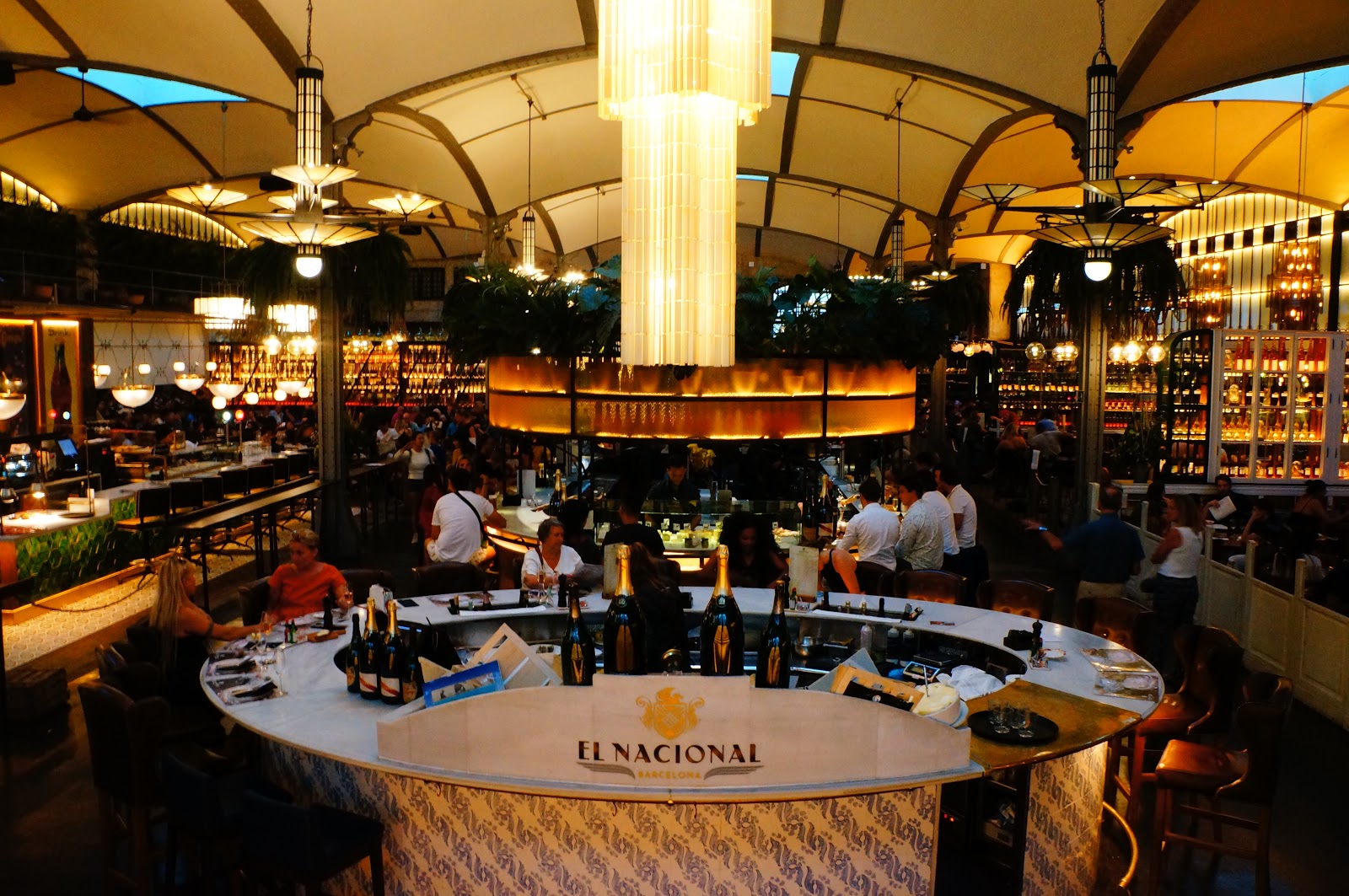
Its location is easily missed. Along Passeig de Gracia, there's a narrow alleyway that leads to El Nacional, the high end collection of restaurants. Located modestly on the side is Praktik Essens.


Upon entering the lobby, you'll see a large collection of scents. That's the specialty of the hotel, and you even get to pick your toiletries based on your favourite scent - herbs, floral or the sea. We chose the sea, which is a fresh citrusy scent. They gave us two packs, each containing bottles of shampoo, conditioner, shower gel, body lotion and a bar of soap. So very pretty and elegant.


Whenever we enter a new hotel room, it's always with bated breath. Will it do justice to its pictures? Or would it be more accurately described as false advertising? Well, when we entered our room in Praktik Essens, Andre gasped and said, "This is the best hotel room we've ever had!"

Possibly an exaggeration but this self-declared "two star hotel" certainly went beyond all our expectations. It's impeccably furnished with a generous king bed and a twin. It's large, with even space for a small table and writing area. There's a separate WC room, a generous shower stall and two sinks. There's no kettle but it has a capsule coffee maker. No fridge though, but we don't care. We love it.


On the first floor foyer, there's a lounge with free coffee and tea, and an outdoor terrace. What a find! Missing out on Praktik Rambla turned out to be a blessing in disguise. I whole-heartedly recommend this hotel to everyone coming to Barcelona.


Nothing left to do for the rest of the day except go for our first dinner in Barcelona. That had to be at Ciudad Condal, which was highly recommended by my friend. Some diners online call this the "best tapas place in Barcelona". It's a 4-minute walk from our hotel and we thought we were early reaching there at 6.30pm but already there was a line. We only had to wait 15 minutes though and actually, the wait was good because it gave us time to study the menu, which was quite confusing. We were really at a loss as to what to order, and ended up peering over at the bar area trying to figure out which tapas in the display windows looked good (and then playing match the items on the menu!)


In the end, this was what we ordered:

Tomato bread, prawn and guacamole skewer, pear and gorgonzola, Iberian ham
Sirloin with foie sauce
Octopus
Cod with ham 
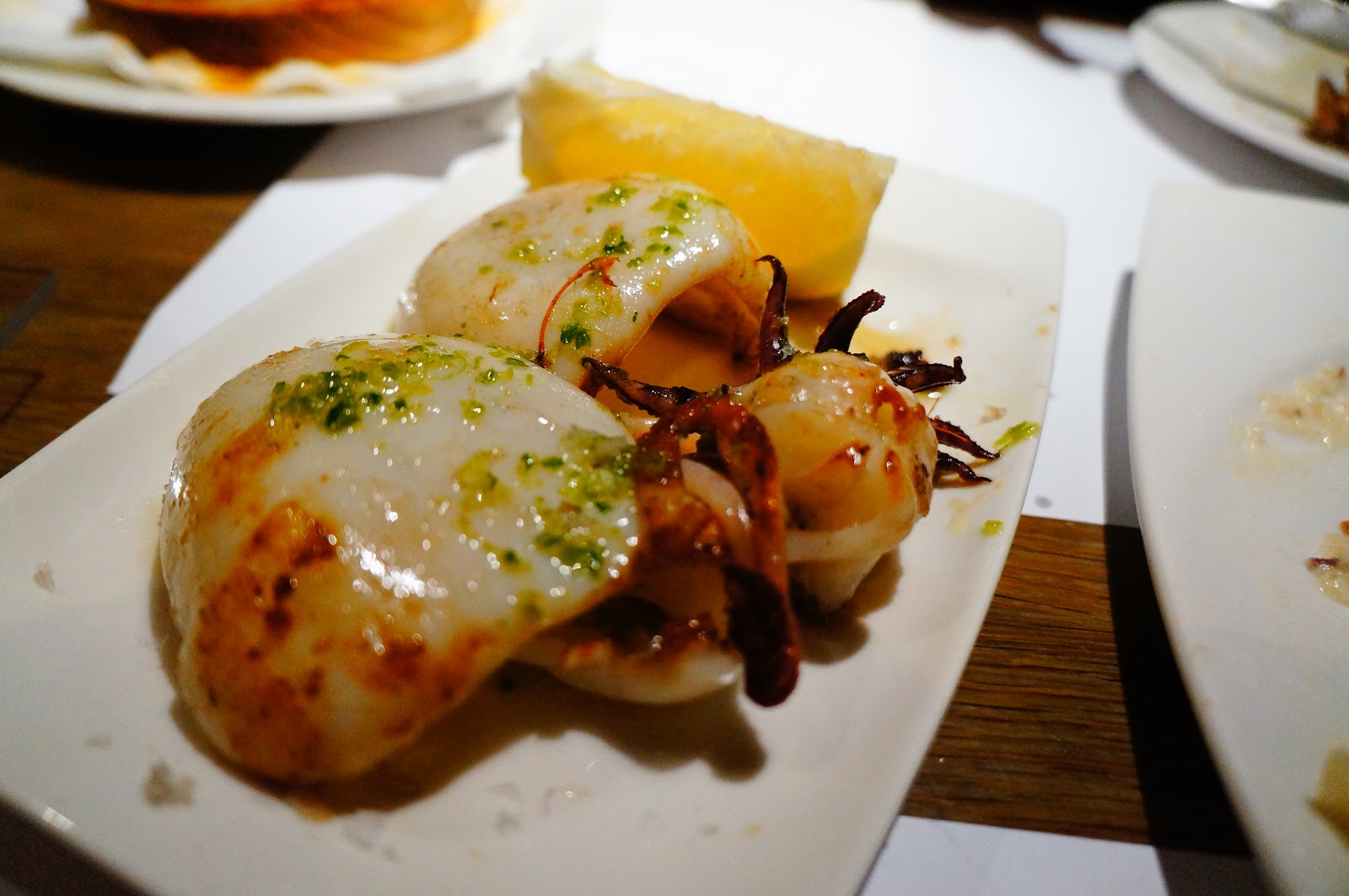
Grilled squid

Apart from the tomato bread which the waiter recommended as a good pairing with the ham, everything else was an anyhow order by us. Either we really lucked out in our order or everything they serve there is good, because I'm not kidding when I say every single item we ordered was mind-blowing. (A couple at the next table leaned over and told us we "ordered very good items", then proceeded to order some of what we did, lol!) My friend had warned me about the curt service but we had a very friendly waiter who made us feel really welcome.

Words do no justice to the flavours. How can octopus taste so utterly delicious? Simple tomatoes on bread? It's just unfathomable. The pear and gorgonzola tapas didn't look like much but it was so magnificent that we ordered another one. Simply culinary magic. We'll be back. (By the way, the signs on the restaurant read Cuitat Comtal but the name cards inside the restaurant are printed Cuidad Comdal. Spanish mystery.)


Before we popped back into our hotel, we dropped by El Nacional. Not to eat, of course. We were stuffed, plus it's too atas a place for us.


But we did get an ice-cream cone - a mix of pistachio and dulce de leche (very, very good!) Because it's always nice to end the day on a sweet note.


Tuesday, October 3, 2017

Travel tips to Osaka and Kyoto

Day 8 (Sat, 30 September 2017)

It was bye bye Osaka for us, bright and early, to catch the 10.55am flight back to Singapore.

Getting to Kansai Airport from Namba station is quite straightforward. Take the Nankai Line (Limited Express Rapit takes about 38mins). I recommend booking online to enjoy a discounted price of Y1,130 (one way) vs the normal price of Y1,430. Don't worry, you don't need to specify the time of the train when you book, just the date. We caught the 7.30am train and arrived at Kansai at 8.11am.

Nothing much to talk about on this day so I'll just share a few tips and observations on travelling in Kyoto/Osaka.

Trains

Trains in Osaka and Kyoto are no different from the ones in the rest of Japan - they're fast and reliable. However, getting on the right train can be confusing, especially in larger stations like Kyoto and Namba. While getting to the correct line is usually easy, we found that their signages for the direction can be a little muddled. Sometimes, the same destination is depicted on the walls for opposing directions, which makes things somewhat confusing.

The frequency of their subway trains is high but less so when it comes to rail. To compound matters, there are often multiple types of trains for one route, eg. express, special and local, with different timings and frequencies. Here's a very useful site to check train schedules and figure out the best route to your destination.


In other words, when travelling on the trains, do give yourself ample leeway in terms of time - at least 15 minutes extra. At times, we'd gotten lost in the station, waited at the wrong platform or gone to the wrong counter to collect tickets. Since some trains run only every half an hour or so, going early also means you have a higher chance of getting a seat.

Wifi

Many places in Osaka and Kyoto offer free wifi, whether at the hotels, train stations or cafes.


However, the strength of the connection varies. Even in our five-star hotel, the connection dropped intermittently. For this reason, I highly recommend Changi Wifi. At only $5 a day, you get wifi on the go for your family (it also provided incentive for my kids to stick close to me if they wanted wifi 😆). Having wifi on the go is particularly useful in areas where there are simply no road names or English names. Many a times, we couldn't find our destination using a regular map and had to resort to using google maps for walking directions. Saved us from getting lost.

Fruit and Veg

I'd noted this in my Tokyo trip 9 years ago, and it's still true of Osaka/Kyoto today. Fresh fruit is a rare commodity in Japan. For those of us who are used to eating 1 or 2 servings of fruit each day, we found it very difficult to keep this up in Osaka/Kyoto. At the supermarket, the selection of fruit is puny compared to what we're used to, and ridiculously pricey. Most fruit is sold singly, even bananas, and it's hard to find anything under Y250 (about S$3).

In the markets, we saw melons being sold at about S$8 a SLICE and these weren't even the premium gift melons famed in Japan, just ordinary ones. This photo was taken at Kuromon Ichiba Market. Peaches for up to Y2,500 (about S$30) each and grapes for Y1,500 (about S$18) per punnet.


I'm not sure why this is so. I tried searching on the Internet and some say it's because Japan has very strict standards on fruit - it has to be perfect before it can be sold, hence the high prices. Others say it's due to high import taxes on fruit. Whatever it is, it seems like fruit to the Japanese is a premium item like cake to us, not something you eat every day.

Same goes for veggies. In meals, it's rare to see a lot of fresh veg. You tend to get only pickled veg in small quantities. On our first night back home, it was wonderful to be able to eat a huge plate of stir-fried broccoli - I think we ate more fresh veg in that one meal than in our entire trip put together.

There's not much you can do about this but if you want to get your servings of fibre without spending a fortune at the supermarket, one option is to bring bags of dried fruit like raisins, prunes or apricots. 

What to Buy

Obviously this is up to individual preference, but go for Japanese goods (duh). Very popular among tourists are Japanese cosmetics, which are a lot cheaper in Japan than in Singapore. For instance, the  Liese hair colour sells at Watson's for S$19.90, whereas in Osaka, you can get it for Y650 (about S$8). Incidentally, Japanese women go ga-ga over mascara and eyeliner - these two items hog advertising space throughout the city, even on trains. And speaking from personal experience, nothing beats Japanese brands in this department.


Furthermore, most of the discount stores offer tax-free shopping. Just bring along your passport for a waiver of the 8% tax. You can find these beauty stores all over Dotonbori.

Of course, another huge shopping hit is Uniqlo. There's a large outlet at one end of Shinsaibashi. And for us foodies, surprise surprise...food! We love snacks that you can't find in Singapore. Edamame bean Pretz! Calpis sweets! Sake Kit Kat! Green tea Cream Collon! So kitschy and so fun. There's no one shop that sells everything cheaper, you'll need to compare. We went to Daikoku at Shinsaibashi which carries both food and cosmetics. The prices there are quite reasonable.


Vending Machines

Ah, the thrill of Japanese vending machines! They sell anything from beer to hot food to umbrellas. What really amazed me though was that they can be found anywhere. Driving must be thirsty business in Japan because there was a vending machine at the entrance of virtually every carpark we passed. Once, we were waiting for the traffic light to change at a traffic junction and there, on the island in the middle of nowhere, was a vending machine.  


Andre was very fascinated by drinks he'd never heard of before. Who knew Coke could be a health drink?


He tried this one that quickly became a favourite - Fanta Kiwi!


English Signs

Finally, Japan wouldn't be Japan without their idiosyncratic use of the English language. I was very tickled by many of their signages.

Delicious hormone therapy
Japanese lifts are very kind - they never put you down.
It sells clothes.
There IS such a word but it probably isn't what they mean.
Okaaay.
Sometimes, it's really just gibberish.

And that's a wrap! Japan is one of my favourite holiday destinations - it's unusual and strange but in a comforting way, like a good friend with a quirky personality. It's a land of contradictions. The people are reserved but warm. The latest technological advancements co-exist easily with century-old traditions and customs. People can don kimonos one day and manga outfits the next.

And of course, the food is simply to die for. If you've never visited the land of the rising sun, I recommend you do so soon.

Arigato gozaimasu!